Military
Modeling, simulation and readiness engineering for complex, mission-critical logistics networks.
Corporate profile · 2026
Security is not added to a supply chain afterward. It is the byproduct of a system designed to explain, verify and protect every movement.
Columbia One works in strategic partnership with SIMS World Wide, combining international trusted-trade, supply-chain analysis and security expertise with Columbia One’s regional delivery, technology integration and stakeholder orchestration.
01–04 · Heritage & doctrine
Columbia One is a supply-chain analysis and optimization company with security and compliance built into the same discipline. Its foundations lie in stochastic modeling, readiness engineering and the economics of cross-border trade.
Modeling, simulation and readiness engineering for complex, mission-critical logistics networks.
Program design, customs training, policy advocacy and institutional capability building.
Supply-chain optimization, regulatory compliance and resilient internal controls.
02 · The mathematics of readiness
Discrete-event Monte Carlo simulation models failure, repair, demand and finite resources as distributions—not point estimates. Thousands of replications reveal the operational range, then optimization solves backward for the resources, placement and staffing required at least cost.
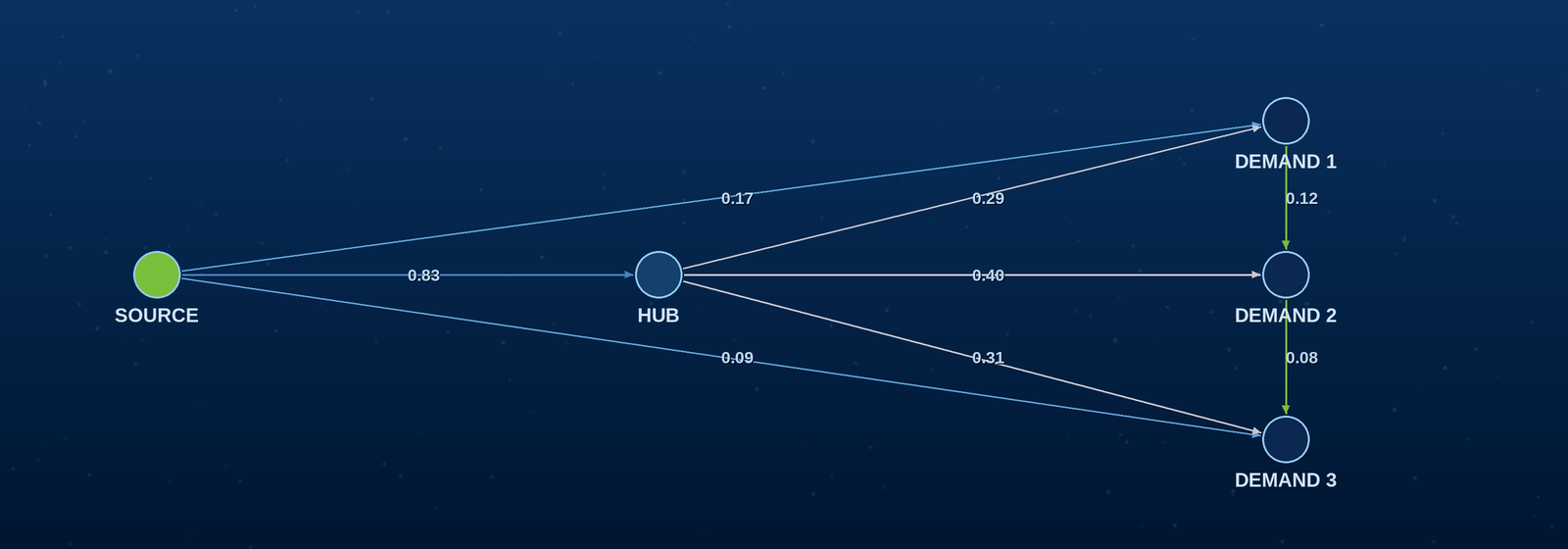
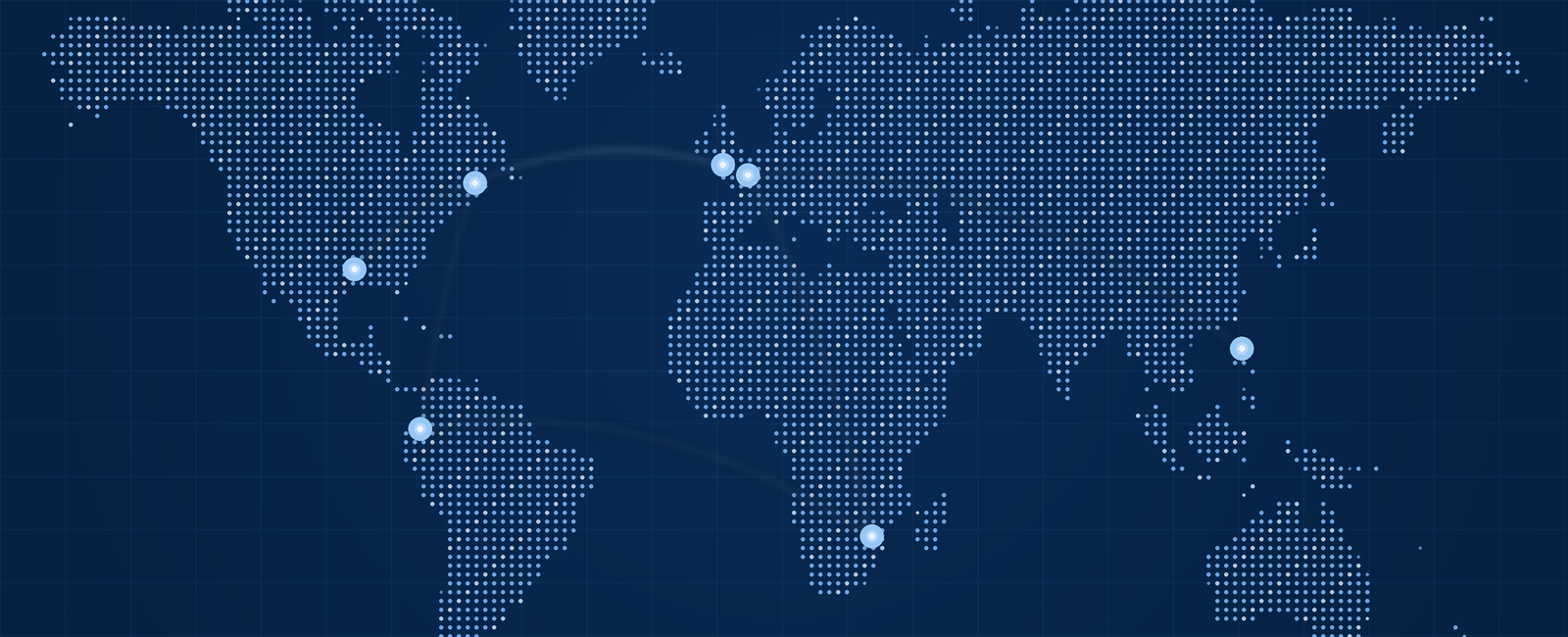
Stochastic modeling and readiness simulation for critical military programs.
Supply-chain economics enters the security discussion as CTPAT is formed.
Validator and auditor training turns a single course into an operating discipline.
International engagements advance AEO, custodial security and customs modernization.
Security imposed without regard to how trade runs can cost as much as the threat it is meant to address.
05 · The architecture of trade integrity
Every movement is read through two interacting planes. The regulatory plane establishes the expected context. The evidentiary plane reconstructs reality. The difference is the signal.
The regulatory plane
Which obligations govern the movement?
Who is accountable, and in what role?
What event, declaration or exchange occurred?
The evidentiary plane
The physical movement across modes, borders and custody.
The capital that moves with the cargo.
The data that governs both, immutable and verifiable.
06–13 · Expertise & method
Customs knowledge, quantitative engineering and risk intelligence are brought together as one operating method—from policy and program design to implementation, validation and continuous improvement.
End-to-end support for governments and companies, aligned with WCO standards and informed by more than two decades of AEO and CTPAT experience.
Time × Quality × Cost optimized against service, working capital, security and throughput.
Threat × Vulnerability × Consequence translated into action through People × Process × Technology.
Defensible controls across the full lifecycle of an entry.
Lawful, evidence-based responses to tariffs, trade fraud, importer accountability, origin integrity and forced-labor traceability.
Security, speed and economic performance delivered as optimized system outcomes—not competing trade-offs.
06 · Continuity & credibility
The May 2019 Minimum Security Criteria reorganized the program into three focus areas and twelve categories, introducing cybersecurity, agricultural security, and security vision and responsibility as explicit priorities.
14–16 · Innovation at the border
Columbia One unifies port community systems, single windows, legacy customs systems and physical security technology into coherent, intelligent operations.
Columbia One film · 60 seconds
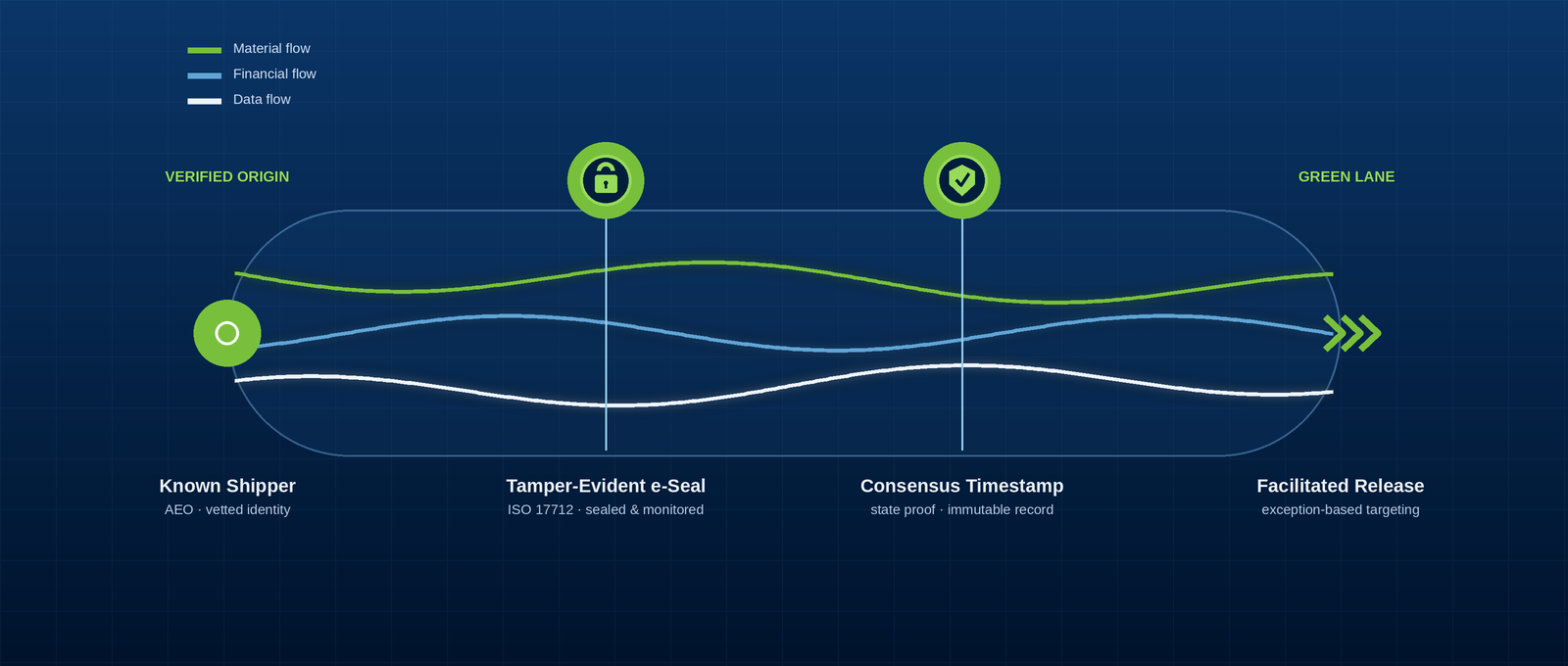
Authorized identities, accountable roles and verified business relationships.
Tamper-evident electronic seals and traceable authorized handoffs.
Material, financial and information flows preserved as verifiable evidence.
Congruent trade moves; unresolved variance receives proportionate intervention.
14 · Technological innovation
Systems serve strategy—not the reverse. Technology amplifies human capability and makes judgment more precise.
17 · Smart trade & community systems
Columbia One designs and integrates the operating layer that connects physical cargo evidence, advance trade data and community-wide workflows—without locking governments or operators into a single device vendor.
Cargo visibility
Real-time and milestone-based visibility across road, ocean, air and multimodal journeys. Configurations can combine location, temperature, light, shock, door and tamper events with route deviation, dwell and exception alerts.
Pre-arrival compliance
Connect advance cargo information and secure digital trade documents to risk, shipment and clearance workflows—supporting faster validation before cargo reaches the border.
Trade & financial integrity
BigBear.ai-enabled analytics can screen commercial invoices and supporting trade records for duplicate billing, manipulated values or quantities, suspicious supplier or payment-detail changes, document inconsistencies and unusual transaction patterns—risk-scoring exceptions for human review while preserving an auditable evidence trail.
Cross-border orchestration
Link origin and destination gateways through shared shipment milestones, verified documents, custody evidence and exception handling—while preserving national data ownership and control.
Maritime community
Portall India technology can connect port authorities, customs, terminals, shipping lines, freight forwarders, truckers and financial services through coordinated digital workflows.
Air cargo community
Kale Logistics technology can unite airport operators, airlines, cargo handlers, customs, freight forwarders, brokers and truckers on one shared digital cargo ecosystem.
Vendor-neutral by design
Each deployment is configured around route coverage, cargo risk, regulatory approvals, data-sovereignty requirements and service levels. Named technology providers represent integration options; final scope and commercial participation remain subject to project-specific agreements.
Design your solution18 · A proprietary discipline
The index compares the expected path of each product, shipment and transaction with the actual path, classifies variance across five dimensions, and quantifies financial and operational exposure.
Is the product in the authorized channel?
Did we receive what we were entitled to, and pay only what we owed?
Does product movement match reported sales to the exact break point?
Did the product cross the border through the right party, rules and documents?
While it was moving, did we maintain control—and can we prove it?
19 · Congruent trade
An unresolved mismatch across party, quantity, route, money or custody.
A real and explainable change whose reason and evidence must be tested.
Cargo, value, route, parties and documents align with the authorized baseline.
10 · Proven on six continents
International work has spanned trusted-trader program design, customs training, custodial-control pilots and trade-technology modernization.
Present at the formation of CTPAT; program training and development of supply-chain security specialists and regulatory auditors.
Selected for an AEO and cargo-security pilot supported through WCO and SIDA cooperation.
Custodial-control assistance recognized by the national customs authority, with program elements reflected in law.
Customs-modernization engagement through the WCO IT Conference and international trade community.
Trusted-trader and customs work spanning mutual-recognition partner jurisdictions.
Continuous engagement on AEO, technology, risk management and the border of the future.
20 · How we work
Every engagement begins with a conversation: your constraints, your objective function, the expected path, the evidence that reconstructs reality, and the proportionate response that follows.
The Columbia One foundation
“Assumed trust is not scalable. Verifiable truth is engineered at every touchpoint.”